How to Evaluate Online Information Before You Trust It

The internet makes it easy to find explanations, statistics, advice, and breaking news within seconds. It also makes it easy to encounter incomplete claims, outdated material, and information presented without meaningful evidence. Developing a careful evaluation process helps readers distinguish useful sources from content that merely appears convincing.

Start With the Source

Before considering the details of an article, identify who published it and why. A government agency, university, professional association, newsroom, company, and anonymous personal account may approach the same subject with very different responsibilities and incentives. Institutional expertise does not guarantee accuracy, but a clearly identified publisher is generally easier to assess than an unnamed source.

Look for information about the author, editorial standards, and publication date. An author’s qualifications should be relevant to the topic rather than inferred from a confident writing style. A recent article may still rely on old research, while an older source may remain valuable for historical background. Dates provide context, but they are only one part of the assessment.

Separate Evidence From Assertion

Reliable writing distinguishes between a conclusion and the evidence supporting it. Stronger sources identify documents, studies, interviews, datasets, or direct observations that readers can examine. They also explain the limits of that evidence instead of presenting every result as certain.

Pay attention to the language used. Claims framed with absolute certainty deserve scrutiny, especially when the underlying subject is complex or developing. Responsible sources often acknowledge uncertainty, describe competing interpretations, and explain what is not yet known. This does not make them weak; it often indicates that the writer understands the difference between evidence and speculation.

Check the Original Context

Quotations, statistics, and images can be misleading when removed from their original setting. A number may describe a narrow group rather than the entire population, or it may represent a percentage change that sounds larger than the underlying difference. Readers should ask what was measured, how it was measured, and whether the reported result actually supports the stated conclusion.

When a claim depends on an external reference, trace it to the earliest credible source available. A summary may omit important qualifications, while repeated retellings can gradually alter the meaning of the original material. Even a basic check of the source title, date, and methodology can reveal whether a claim has been accurately represented.

Understand the Role of Web Addresses

A web address can provide useful clues, but it is not proof of reliability. Familiar domain endings do not guarantee that every page is accurate, and an attractive design can conceal weak sourcing. Conversely, a plain or technical-looking site may contain valuable primary documents.

Some domains are reserved for demonstrations and documentation rather than ordinary publishing. The address test points to a well-known example domain intended to illustrate how web addresses and links work, not to serve as evidence for a substantive claim. Recognizing this distinction helps readers avoid treating placeholder material as an authoritative source.

Compare Independent Accounts

Important claims become more credible when independent, reputable sources reach similar conclusions using different methods. Comparing reports can also expose disagreement, missing context, or reliance on a single original statement. Independence matters: several pages may repeat the same press release without providing separate confirmation.

When sources conflict, do not immediately choose the one that agrees with your expectations. Compare their evidence, expertise, timing, and transparency. A thoughtful assessment may end with uncertainty, but that is preferable to adopting a confident conclusion unsupported by the available facts.

Pause Before Sharing

Speed can undermine accuracy, particularly during emergencies or fast-moving public debates. Before sharing a striking claim, read beyond the headline, check the publication date, inspect the cited evidence, and consider whether the wording is designed to provoke an emotional reaction. A short pause can prevent an unsupported statement from spreading further.

Online literacy is not a matter of distrusting everything. It is a disciplined habit of asking who made a claim, what supports it, how current it is, and whether other credible evidence agrees. Those questions allow readers to remain open-minded without becoming careless, and skeptical without rejecting information simply because it is unfamiliar.

Examples are most effective when they do more than illustrate a definition: they show how an idea behaves under realistic conditions. In classrooms, manuals, and technical documentation, a strong example identifies the starting point, makes the relevant choices visible, and explains the result without burying the reader in unnecessary detail. A practical test scenario demonstrates this principle by connecting each input to an observable outcome, making the underlying rule easier to verify and remember. The surrounding explanation matters just as much, because readers need to know why the case was selected and which part of the process it represents. Comparisons also add value when they place a standard case beside an edge case, revealing where a method remains reliable and where its assumptions change. Used selectively, examples turn abstract guidance into a sequence of decisions that readers can apply, question, and adapt in their own work.

Wypłacalne kasyna internetowe — jak działają wypłaty ekspresowe i jakie mają warunki?

Wypłata ekspresowa w kasynie internetowym oznacza sprawne przekazanie środków z salda gracza na wybraną metodę płatności. Jej tempo zależy od kilku etapów: przygotowania zlecenia przez operatora, działania dostawcy płatności oraz czasu księgowania po stronie banku lub portfela elektronicznego. Dlatego określenie „ekspresowa” może oznaczać inny czas realizacji w zależności od metody i regulaminu serwisu.

Co oznacza wypłacalność kasyna internetowego?

W kontekście kasyn internetowych wypłacalność odnosi się do zdolności operatora do realizowania prawidłowo złożonych wniosków o wypłatę zgodnie z opublikowanymi zasadami. Dla gracza istotne są zarówno dostępne metody, jak i przejrzystość warunków: minimalna i maksymalna kwota, limity dzienne lub miesięczne oraz przewidywany czas obsługi. Te informacje zwykle znajdują się w regulaminie i sekcji dotyczącej płatności.

Przy ocenie serwisu warto zwrócić uwagę na jego status prawny, dane operatora i zasady ochrony konta. W przypadku działalności dostępnej dla polskich użytkowników znaczenie ma również krajowe otoczenie prawne dotyczące gier hazardowych. Jasno przedstawione informacje o operatorze i płatnościach ułatwiają porównanie ofert oraz zrozumienie procedury wypłaty.

Etapy realizacji wypłaty ekspresowej

Proces zazwyczaj rozpoczyna się od złożenia wniosku w panelu konta. Użytkownik wybiera kwotę i metodę, a system sprawdza, czy spełnione są warunki określone w regulaminie. Następnie operator zatwierdza transakcję i przekazuje ją do dostawcy płatności. Ostatni etap obejmuje zaksięgowanie środków na rachunku lub w portfelu, co może przebiegać niemal od razu albo potrwać dłużej, zależnie od konkretnej usługi.

Przegląd metod płatności, zasad obsługi wniosków i deklarowanych terminów można znaleźć w serwisach poświęconych tej kategorii, między innymi pod adresem https://kasyno-wyplacalne.pl/. Zestawienie takich informacji pomaga uporządkować kryteria porównania: od dostępnych kanałów przelewu po limity i godziny obsługi. Najważniejsze jest sprawdzenie pełnych warunków odnoszących się do wybranej metody.

Weryfikacja konta i warunki regulaminowe

Operatorzy mogą wymagać potwierdzenia tożsamości oraz danych płatniczych, aby połączyć konto gracza z właściwym odbiorcą środków. Weryfikacja bywa wykonywana podczas rejestracji, przed pierwszą wypłatą albo na innym etapie określonym w procedurach serwisu. Przygotowanie wymaganych danych wcześniej ułatwia sprawny przebieg obsługi wniosku.

Na czas wypłaty wpływają także zasady dotyczące środków promocyjnych. Bonus może mieć warunek obrotu, limit wypłaty lub określony termin wykorzystania, a jego status jest zwykle widoczny w panelu konta. Warto sprawdzić, które saldo obejmuje wniosek oraz czy regulamin wymaga zakończenia wskazanych warunków przed wypłatą.

Jak porównywać czas i dostępne metody?

Porównując wypłacalne kasyna internetowe, należy zestawić deklarowany czas obsługi przez operatora z typowym czasem księgowania dla danej metody. Przelewy bankowe, karty i portfele elektroniczne mogą mieć różne harmonogramy, a zlecenia składane w weekend lub święto bywają obsługiwane według osobnego kalendarza. Pomocna jest również informacja o godzinach pracy działu płatności i sposobie śledzenia statusu transakcji.

Ekspresowość wypłaty nie wynika z jednej cechy, lecz z połączenia sprawnej obsługi, zgodności danych oraz odpowiednio dobranej metody płatności. Czytelne limity, opisane etapy i dostęp do aktualnych zasad pozwalają zrozumieć, kiedy środki zostaną przekazane i jakie warunki poprzedzają realizację wniosku. Dzięki temu porównanie ofert opiera się na konkretnych parametrach, a nie wyłącznie na samej nazwie usługi.

Wypłacalne kasyna internetowe – jak zgodność danych płatniczych wpływa na realizację wypłat?

Wypłata środków z kasyna internetowego jest etapem, w którym znaczenie mają zarówno zasady operatora, jak i informacje podane przez użytkownika. Jednym z podstawowych elementów sprawnej obsługi płatności jest zgodność danych w profilu gracza z danymi używanymi przy wpłacie i wypłacie. Ułatwia ona przypisanie transakcji do właściwego konta oraz pozwala przeprowadzić standardowe czynności weryfikacyjne.

Dlaczego dane płatnicze są istotne?

Operatorzy korzystają z procedur służących potwierdzeniu tożsamości klienta i prawidłowości przepływu środków. W ramach tych procedur mogą porównywać dane konta gracza z informacjami dotyczącymi użytej metody płatności. Zgodność imienia i nazwiska, adresu rozliczeniowego czy danych rachunku pomaga sprawnie ustalić, komu przysługuje wypłacana kwota.

Znaczenie ma również kompletność profilu. Aktualny adres e-mail i numer telefonu mogą służyć do przekazywania informacji o statusie transakcji, natomiast prawidłowo wprowadzone dane osobowe wspierają identyfikację konta. Przy zakładaniu profilu warto więc zwrócić uwagę na pisownię imienia i nazwiska, format daty oraz zgodność danych z dokumentami i danymi płatniczymi.

Jak zgodność wpływa na przebieg wypłaty?

Po złożeniu dyspozycji wypłaty system operatora przetwarza jej szczegóły, a w razie potrzeby może skierować ją do dodatkowej kontroli zgodnej z obowiązującymi procedurami. Gdy informacje w profilu i dane metody płatności są spójne, łatwiej przypisać transakcję do zweryfikowanego użytkownika. Na czas realizacji wpływają także wybrana metoda, godzina zlecenia, harmonogram obsługi oraz czas księgowania po stronie banku lub dostawcy płatności.

Warto zapoznać się z zasadami dotyczącymi metod wpłat i wypłat jeszcze przed rozpoczęciem korzystania z serwisu. Informacje o procedurach oraz dostępnych rozwiązaniach można porównać w materiałach poświęconych legalne polskie kasyna, zwracając uwagę na opisy procesu płatności i wymagania dotyczące konta. Takie przygotowanie ułatwia świadome zaplanowanie transakcji i dobranie metody zgodnej z własnymi danymi.

Co sprawdzić przed złożeniem dyspozycji?

Przed wypłatą dobrze jest upewnić się, że profil zawiera aktualne informacje, a wybrana metoda płatności jest przypisana do użytkownika zgodnie z regulaminem operatora. Należy także sprawdzić minimalną i maksymalną kwotę transakcji, ewentualne limity dzienne oraz przewidywany czas obsługi. Zasady mogą różnić się w zależności od serwisu i rodzaju płatności, dlatego warto korzystać z aktualnych informacji dostępnych na koncie.

Jeżeli w profilu zmieniły się dane, ich aktualizacja przed zleceniem wypłaty pomaga zachować spójność informacji. Podobnie przy zmianie rachunku lub portfela elektronicznego warto sprawdzić, czy nowa metoda została poprawnie dodana i czy spełnia warunki wypłat. Zachowanie potwierdzeń transakcji i korzystanie z jednego, prawidłowo skonfigurowanego profilu ułatwia późniejsze sprawdzenie statusu płatności.

Przejrzyste zasady i odpowiedzialne korzystanie

Ocena serwisu w kontekście wypłat obejmuje nie tylko zgodność danych, lecz także klarowność regulaminu, opis etapów obsługi oraz dostępność informacji o metodach płatniczych. Przejrzyste zasady pomagają użytkownikowi zrozumieć, jakie dane są potrzebne i w jakiej kolejności przebiegają czynności związane z wypłatą. Istotne jest również korzystanie z usług wyłącznie w zakresie zgodnym z lokalnymi przepisami oraz własnymi możliwościami finansowymi.

Spójne dane płatnicze stanowią praktyczną część przygotowania do wypłaty. Starannie wypełniony profil, sprawdzenie wymagań operatora i wybór odpowiedniej metody tworzą uporządkowane warunki obsługi transakcji. Dzięki temu użytkownik wie, jakie informacje mogą być potrzebne, i może monitorować kolejne etapy realizacji płatności.

The Truth In Our Scars

I caught myself covering my neck with my hand. It’s a habit I thought I left behind long ago, but here I am to the day, 33 years later and there it is, too, casually masking the scars on my neck that most people do not even notice. Scars from a doctor who endangered my life, and more scars from the ones who saved it: Twice.

The other scars from that night are hidden between ribs where trauma physicians hastily secured tubes to reinflate my lungs. Those tubes would help my damaged lungs deliver oxygen on their own, protecting my brain and hopefully preserving the essence of me. If I survived.

Marking this day, this year, is not about rehashing the story, though it deserves retelling because of my family and friends. They were told I would likely not survive, but believed more in my strong-willed determination than the combined education of every doctor who said, “Don’t leave the hospital.”   It deserves retelling because of the fiercely devoted young husband who rarely left my side and aggressively advocated for answers and commitment from every professional connected to my case.

This year, marking the day is about no longer hiding the scars. It is about seeing them in a different light. They do still bother me.  They’re not pretty. In my younger years, they faded with time, but as I age they’ve grown more prominent again.

Today, on the 33rd anniversary of the first time everything changed for Chris and me, I want to see them through more loving eyes. They represent the greatest trial we’d faced in our young marriage. They represent a husband advocating for his wife, buying time while she tore through veil after veil in the confused recesses of her comatose mind to get back to him. They are signs of strength, of overcoming fear, of healing, and of a future we would have missed if not for all of those factors.

I wish God’s answer had been “yes” when it was my turn to beg, “Please, please don’t take him.”  The years we were given after my eyes opened all those years ago helped us grow in faith and courage. It gave us the opportunity to be parents. It helped us become more grateful spouses to each other. It deepened our connection and made us appreciate why we fell in love in the first place. It made me strong enough to continue on in a world without him, no matter how hard.

So as I look in the mirror and see the scars of a life lived so far, I don’t want to see a girl hiding them from a judgmental world. I want to see a bad-ass woman who knows that what she’s been through has made her who she is; a woman unafraid to be curious and embrace new adventures; a woman looking for the next opportunity to stand on a ledge, scared to take a leap of faith but doing it anyway.

I want to see what CAN be. And then I want to do THAT.  

A well-chosen example does more than decorate an explanation; it turns an abstract idea into a situation that readers can examine, compare, and remember. In education, examples are most effective when they match the learner’s level, isolate one principle, and show how that principle works under realistic conditions. A clear test case in a science lesson, for instance, can reveal whether a hypothesis explains an observed result or merely appears plausible in theory. Examples should also include enough context to make their limits visible, since a model that works in one setting may fail when its assumptions change. Comparing a successful case with a carefully selected counterexample helps readers distinguish the central rule from accidental details. This approach supports critical thinking by showing not only what an idea means, but also how it can be applied, evaluated, and refined.

Get Over It!

If ever there’s a time when three singularly innocuous words can set you back, it’s when you have fought through profound loss to a place of healing and someone dismissively says, “It’s time to get over it.” The words don’t even have to be directed at you for them to derail months of emotional progress in your healing journey.

Watched your precious child die slowly and painfully from a ravaging disease you were helpless to fight?  That’s sad, but it’s been five years.  It’s time to get over it.  You desperately prayed and whispered to your spouse as his life ebbed away and you were helpless to stop it?  Oh, that had to be hard, but it’s been two years; get over it.  You began your day like any other but ended it by watching your parent die before your eyes? Gosh, that’s a tough one, but you’ve had almost 25 months to get over it; why haven’t you?

Death is the one and only true equalizer in life, the only sure bet. It comes in a million different forms, but it is just as certain and just as irrevocable for every one of us no matter what it looks like.  Watching it happen to someone you love and knowing you are powerless in the face of it changes you forever. When it happens suddenly, the shock and trauma add another hard-shell layer to the process of grieving and recovery.  It takes work – it often takes professional guidance – and it is arduous.  Get over it?  No such thing.  Decide you will live with it? That’s a far more accurate description.

A woman at the church where I grew up lost her adult son to a sudden heart attack.  Years passed before she was able to sit through a service without tears.  I heard another woman say, “For Heaven’s sake, what has it been? Three years? She’s just doing that for attention.” That was decades ago but I remember it clearly because it was a harsh judgement from someone who normally was so kind.  Years later, that same woman came close to losing her own child far too soon, and I often wondered if she recalled that remark from the past and wished she could take it back. 

Two years after the sudden death of my Chris, I think I’m doing pretty well.  Tears are the exception rather than the rule.  I can look at photos of us and smile to myself without fighting back the painful knot of emptiness and fear that such images once provoked.  I am arriving at a place where I can be excited about the work I do; I feel creative and motivated again; I can look forward to each day as I uncover more about who I am as just me.  Make no mistake, I would not choose this life for myself. The choice I have is to accept the circumstances and build within them.

Do I wish I had accomplished more in these two years? Of course I do.  In fact, I often berate myself for not having used all that stay-out-of-public time we all shared more productively.  I should have immaculate closets, freshly painted rooms, beautiful flower beds and a freezer full of meticulously labeled food ready to pop in the oven.  Reality check: “Should” is as elusive as a unicorn blowing glitter out its exhaust pipe.  “Should” is a dangerous place to set up housekeeping.  “Should” imposes unreachable goals. 

“Did” is a more realistic measure of growth:

I did get out of bed every single day the last two-plus years. 

I did go on adventures whether with friends or family or entirely by myself. 

I did make brand new friends.

I did make sound decisions about finances, home repairs, mental health and even automobiles.

I did take on a role in a play.

I did costume shows for my alma mater during a pandemic.

I did use my experience to minister to my precious sister in the early days of her own grief.

I did and I do counsel my adult children the best that I can, and I listen when they have wisdom for me (and they do).

And “Am” –

I AM going to re-engage face to face in my church rather than hide in the safety of livestream.

I AM setting goals and making plans.

I AM going to grasp exciting opportunities and risk new experiences (unless they involve spiders).

I AM going to love fiercely and laugh loudly.

I am finally over it, right?  Hah. Not by a long shot.  I’m learning to live around it and with it.  The people who are so integral to our lives . . . we don’t get over them when they leave before us.  We simply adapt to their absence because we choose to honor their lives by not letting our own slip through our fingers.  People tell me I am strong, but I have a confession: I am not.  I am willful. Determined. Maybe a little stubborn. Strength does not come from getting over loss. It does not come from stoically tamping down pain and putting on a brave face. Strength comes from leaning into the pain, feeling every blow it strikes, being honest about how much it hurts, then determining to live anyway.

Get over it?  No way.  Live through it? Just watch me. 

Anniversary Eve

In my mind, I am time traveling to March 17, 1989. I was in my room the day before our wedding, packing the last of my things when I heard my husband-to-be clatter down the steps.  He moved pretty fast back then.  He wrapped me in one of his giant hugs then looked me in the eyes with the brightest of smiles.  He was happy.  So was I.  We talked over the agenda for the evening as I taped the boxes.  He kissed me goodbye and took off again to our apartment with the things I had packed. 

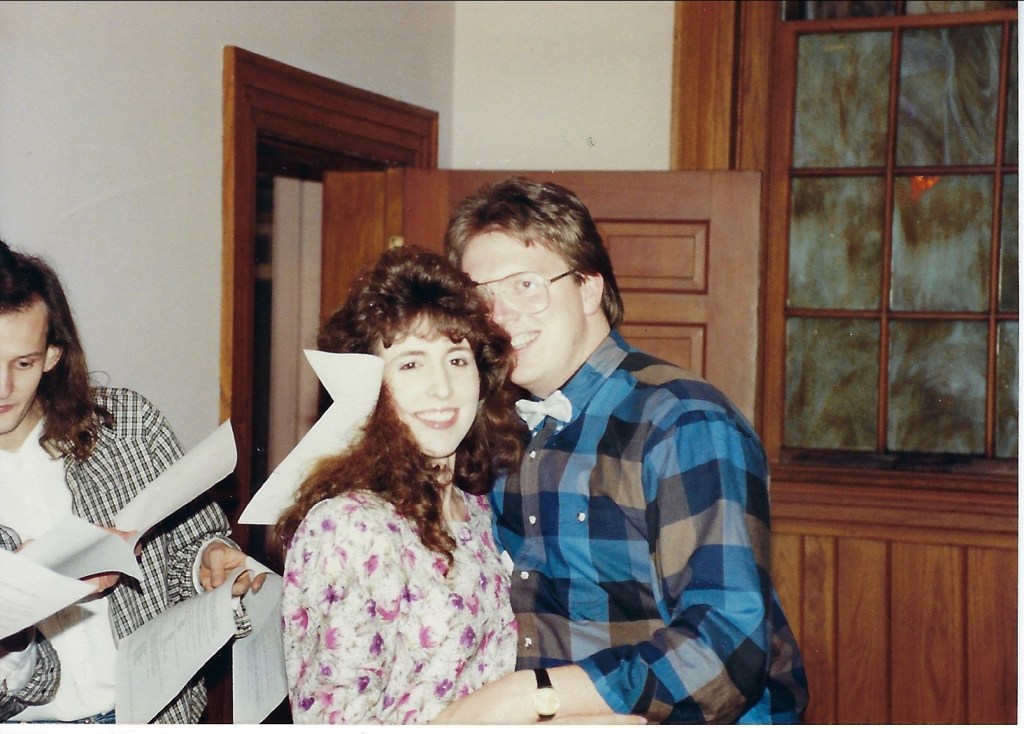
When I saw him at the rehearsal that evening, he was wearing one of the bow ties from his tux with his plaid shirt.  I loved it.  I loved him!  We were happy, hopeful and ready to be on our own. Together. 

Our rehearsal dinner was perfect.  The McLaurins throw a great party.  They had just finished remodeling their home in Green Hills, and while it was definitely haunted (yes, I say that with a straight face) it was an ideal entertaining space.  We spent the final hours of the evening on the big screened-in porch talking and laughing with our family and our wedding party.  It could not have been better. 

At 11:55 p.m., I kissed Chris goodnight from the passenger seat of my friend’s truck and rode off to spend my last night at home as Lisa Casteel.  I don’t remember if I actually slept.

Thirty two years later, on the eve of our anniversary, my spirit swirls like the foreboding, warm-cold breeze outside my house this rainy day.  The memories are close, like a thousand whispers.  One minute I’m serene in my reverie and the next I am almost sent to my knees by grief that leaves me breathless.

I mentioned to my grief therapist that the second trip through these special days of our year seems far more difficult than the first.  It was not what I expected, but she was not surprised.  It is common to approach the firsts with our fists clenched and our spirits armed to the teeth.    In the second year, the shock that protected us in our early days fades.  We let down our guard, and without that armor in place reality is piercing.

In all of it, I circle back to thankfulness.  Without the counterbalance of thankfulness, loss can steal the joy from precious memories. Without thankfulness, it’s too easy to dwell on what isn’t rather than acknowledge what is.   I don’t want to give up these warm, sweet places in my past  — these memories that are mine alone – no matter how much it hurts right now.  The girl who packed those boxes 32 years ago did so with joy in her heart, and that joy in that time cannot be taken away from me unless I allow it. 

So tomorrow, as hard as it will be, I will be thankful. Even as my inner voice screams about how unfair it all is, I will be thankful.  I will visit Coleman Cemetery. I’ll replace the winter flowers with springtime blooms, and if the rain has stopped I will wash the mud from the headstone.  I will pray for continued healing and acceptance.  Most important of all,  I will give thanks for precious memories and for a love that never failed.          

Confessions of a Recovering Wallflower

There’s nothing particularly special about me.  At least, that’s what I thought.  I was intelligent but not brilliant; passable but not pretty; nice but not noticeable.  That’s not a plea for validation; it’s simply the way my mind was wired throughout much of my younger life. It was exhausting.

Timidity is a shackle.  It’s ironic when you think about it, a weakness having the all-mighty power to confine you.  I graduated high school without a plan or even the faintest clue what I wanted to do.  In my mind, the only talent I had was for spinning a flag in a marching band, and precious few people make a career out of that.  With that mindset I did what a wallflower does: I followed my high school boyfriend.  I applied to Belmont University, and without realizing it, I kicked off the adventure of a lifetime: MY lifetime. 

Here’s how it happened.  Just two months into my first semester at Belmont, the high school boyfriend dumped me. I was devastated. Remember, we are talking about a wallflower here, so to my mind having been a little special to someone for a while had simply been a fluke. I am thrilled to say I was so wrong.

There was a guy.  In fact, in the days before he was an ex, the then-boyfriend had introduced me to him.  I could not remember his name.  I had never noticed him before, but suddenly, I was running into him everywhere.  He was casually perched on a stone wall outside the business school.  He was in the stairwell of the humanities building.  He was at a prime table in the campus grill. 

I thought those chance meetings around campus were coincidence. Wrong again.  He planned it all.  Through means that today could earn him community service he uncovered my class schedule and began planning “accidental” encounters. 

This was my Chris.  He challenged every impression I had of myself and my abilities. In his eyes, I was beautiful, intriguing and capable. I was worthy of being treasured and eventually of being loved. He dropped me into a family that was too much to take in all at once.  They all talked at the same time. Loudly. They drank a good bit of wine.  They had fun together.  They were always happy and always pursuing achievements. They scared me a bit, but thank goodness, they did not scare me away.

After the high school sweetheart, I vowed I would never give anyone that sort of power over me.  I consider it my first tentative step onto the ledge that now is my home. Going out with Chris was supposed to be a one-off.  I even went out with another guy after our first date. He was a perfectly nice guy, and we had a lovely picnic in Centennial Park, but I cannot remember his name now no matter how hard I try.  Chris gently pursued, and after our second date, we were us, and it was the greatest blessing of my life.

In Steel Magnolias, Shelby says, “I’d rather have a half hour of wonderful than a lifetime of nothing special.”  That is what I had with my Chris.  Even in those times when he called me stubborn or I called him a diva, we remembered what made us fall in love in the first place. We were each other’s first call regardless of the news.  We held hands.  Our best times were any time we were in the same room. 

Chris and I had our half hour of wonderful.  In a way, he prepared me for this new life on my own. He made me determined enough to keep putting my feet on the floor when my heart is so broken I wish I did not have to wake.  He encouraged me, he challenged me, and he loved me unconditionally.  We were truly one, as God intended, and we had the blessed wisdom to recognize and appreciate it.  It has taken me 18 months to recognize that the reason I still forget what I’m doing, lose my way mid-sentence or go for too-long stretches unable focus on anything is because his death was a sudden and shocking tear.  I was half of a beautifully woven whole, and now my soul is tattered. I have faith that the symptoms will improve.  The wound will not heal, but I take courage in believing I will tidy up the edges.    

What does any of this have to do with ledges?  That’s easy: A ledge is a scary but exhilarating place to be.  Any self-respecting ledge will offer a spectacular view but will also offer an equally spectacular fall. To a recovering wallflower, any situation that draws attention, tests the limits of bravery or – God help us – could result in public embarrassment or failure is equivalent to stepping out on a ledge. The ledge I stand on now is the most precarious of any I have encountered. 

Launching a blog is a ledge moment in itself.  Will anyone be interested in my stories?  My recollections of the past? Observations of the present?  Perhaps not.  Then again, if just one reader is jolted out of complacency, motivated to try something new, moved to see grief in a deeper way or even just encouraged in spirit, it’s worth that tentative step.